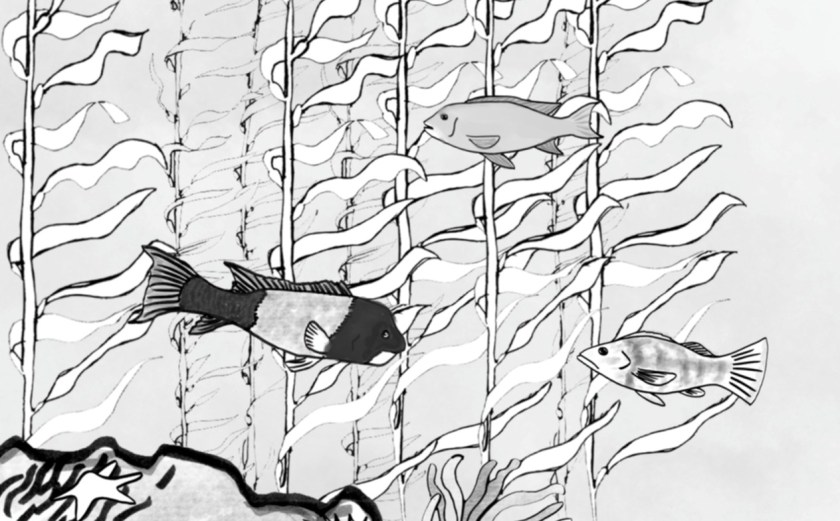
Another gift of a commission: drawing an illustration about sustainable abalone fishing off Isla Natividad in Baja California. Dr Andrea Sáenz Arroyo, author of the inspiring book A Sea of Hope, asked me to draw an illustration for an upcoming publication.
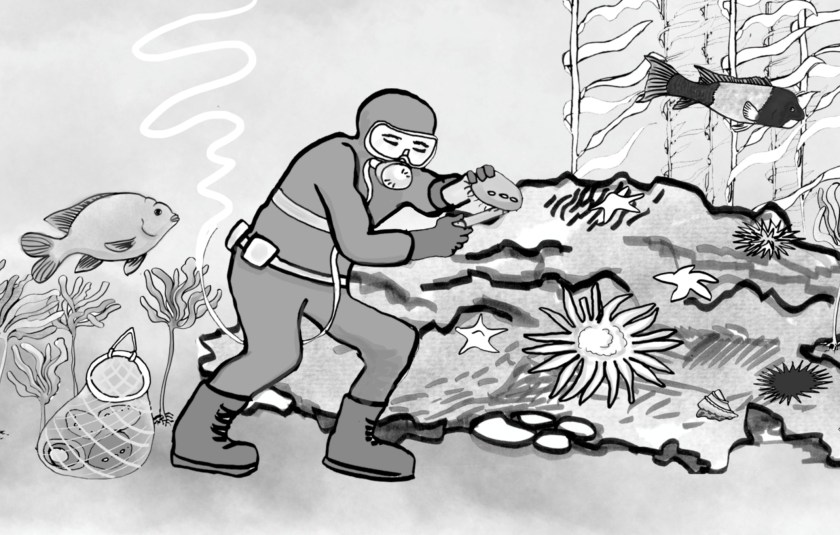
Some of the fascinating things I learned while researching the marine life where haliotis corrugata, the pink abalone, lives:
- The Isla Natividad fishers’ cooperative regulates their seafood harvesting successfully – because they want to keep doing it. Their divers don’t use scuba gear but set out with a bombero, air pump maestro, who keeps the air flowing directly into the divers’ masks!
- In the past only the men would go underwater, but now there is a movement of “sirenas mexicanas” – Mexican mermaids – who scuba dive for conservation. Elba Lopez from Baja California is one of them and publishes glorious underwater footage!
- There are seven types of abalone, and I started to be able to differentiate between them. I discovered Oriana Poindexter, a free diver, researcher and photographer – what a life! She has published a helpful visual guide to the different species of abalone – although when seen in the wild those smooth shells tend to be covered in little camouflage microclimates of algae. One of her ongoing projects is about abalone conservation in California, including a blog with fascinating titles such as “extreme rockpooling”.
- The fish “la vieja”, Bodianus Pulcher, or the California Sheephead, starts off life female and transitions to being male as she grows! Almost as seen in Blue Planet with another grouper.
- The good guy/gal of kelp forest conservation is the sunflower sea star, which eats sea urchins, which eat kelp. In my case the sunflower sea star was the only abalone-habitat creature that gave me the creeps. Fleshy, heavy, with way too many tentacles… and it only gets worse when you see photos of them “literally… [turning] into goo” by sea star wasting disease. You can get involved by tracking the disease if you’re less squeamish than I am! It was light relief to see photos of divers wearing them as hats.